
Endswell Funeral Home Interviewed for American Cemetery & Cremation. – By Tony Russo
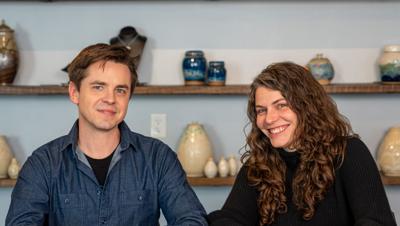
Hunter Beattie and Veronica Penn Beattie in the urn display room at Endswell.
In January 2022, Hunter Beattie was sitting near a cemetery in Carrboro, North Carolina, a small, artist-friendly town adjacent to the University of North Carolina at Chapel Hill, when he first heard about aquamation.
He was reading an article about Archbishop Desmond Tutu’s decision to choose that method of disposition. It was a moment transformative as much for the information he received as where he was when he received it. For the first time, he saw an alternative to the resource-heavy cemetery where moments before he had just seen an open space with a bunch of headstones and people preparing a grave.
Casting his mind to the future, Beattie could see a lot better uses for the area’s quickly diminishing open space than cemetery expansion. He wondered at the plastic flowers on the ground and the ornate caskets below them. In that, he saw an opportunity to reduce what he saw as wasteful practices by offering what he saw as a greener alternative.
By the time he got home, he had a plan to get into the aquamation business and laid it out for his wife, Veronica. Beattie had been looking for a purpose and a way to insinuate himself into the wider community. Aquamation seemed like the perfect fit. It wasn’t death care that intrigued him so much as the service and hospitality aspect of end-of-life planning and care.
“We had thought about running a bed and breakfast, and the similarities are there,” he said. “You’re just there to meet people’s needs, whatever they are, whatever their emotional state is, and provide for them. And we’ve always enjoyed doing that. I saw pretty quickly that this could be the right fit for us and our personalities.”
Find a Need …
From the earliest days, Beattie’s focus was on the ecological aspect of death care, which is where he began evangelizing for aquamation as an alternative to cremation or burial.
“It seemed like an industry worth disrupting, right? You’ve got floral wallpaper and maroon carpet and a bunch of dudes sitting around in suits … the funeral home seems very cut off from the community,” he said. “You have one interaction with it or maybe a couple when your family members die, but it doesn’t provide education and resources and workshops to prepare for end-of-life.”
Whether or not the funeral homes in his area actually did all (or any) of these things is secondary, because his picture of funeral service was the motivator. Beattie bore the moral certainty of the recently converted.
Veronica asked the simple, smart question: Don’t you have to be a funeral director?
Under North Carolina’s cremation (and therefore alkaline hydrolysis) rules, no, you do not. For people running a direct disposition business, there is no need for a funeral director as long as you’re qualified as a cremationist (or in this case, an aquamationist).
Beattie can remove bodies from homes and transport them, make arrangements with families, perform the aquamations, prep the urns, deliver the urns, write the obituaries, and all the other traditional duties besides embalming and selling preneed insurance.
From his perspective, a funeral home wasn’t necessary. His primary focus wasn’t at-need (or preneed, really), it was conversion. He didn’t need people to preplan and prefund as long as they chose aquamation at their time of death.
So, two weeks after reading that article, the Beatties bought the aquamation apparatus and headed to Las Vegas for training at another aquamation facility. It was there, not in mortuary school, that Beattie saw his first dead person outside of a viewing room. It was the first of many experiences that would change his views on funeral service.
“I nearly passed out when this funeral director wheeled out the first body, so this was a very rip-the-band-aid-off experience,” he said. “I wasn’t a funeral director. I had to rely on intuition and genuinely caring about helping the families I worked with.”
Wanting to help families is radically different from being able to help families, but if you’re wanting includes a willingness to learn and change, that becomes an ability.
All’s Well That …
There was some distance between the Beatties’ vision for their company and their situation as relative unknowns. Endswell, as they named their concern, was the second direct aquamation facility in the state and possibly in the country.
The first three months they were open, they didn’t have one call, but Beattie didn’t just sit around staring at the phone waiting for it to ring. He was driven to share everything he already had learned with anyone who would listen.
“I designed classes for continuing education credit to teach hospice nurses and social workers about aquamation, green burial, a history of the modern funeral industry, working with funeral homes, the Funeral Rule, how to save money when working with a funeral home, like ordering your own casket and having it shipped to the funeral home,” he said. “I just started speaking very passionately about something I care about, and it resonated with people. Most of our business is referral-based. We don’t get a lot from Google Ads.”
Beattie ran their operation alone for the first year, handling every aspect from performing aquamations to delivering urns and preparing death certificates.
“Owning a funeral home is a very long-term relationship with the community, and we’ve really been proactive about community outreach, presentations, workshops,” he said. “We do workshops on advanced directives, ‘5 Wishes’ (an advance-care planning system), health care power of attorney. We’ve got yoga classes and meditation classes, monthly death cafés. The idea is that Endswell really interacts with the community.”
It took a while to make that connection stick, but once it did it was pretty solid. As 2023 went on, they would average 10 families per month. Veronica left her solar energy job to help full time.
Last year the Beatties served around 250 families. Together, they now run the business seven days a week, have four staffers, and recently expanded to a second location in Durham, with an eye on another expansion to Raleigh soon. Owning funeral homes hadn’t been part of their initial plan, but it became unavoidable.
“We curated an urn gallery. We’ve got 300 urns all made by local artists,” Beattie said. “Our space looks more like an art gallery than a funeral home, and people wanted to have a celebration of life here because it just felt like a very different space.”
The nature of the aquamation center, with its bright, clean gallery walls, made people want to linger, which complicated things for Endswell. Since Beattie wasn’t a funeral director, he couldn’t have a funeral home. Since he wasn’t a monster, he couldn’t begrudge families a little grace in their time of need. It raised something of a philosophical question: When is a viewing a funeral?
“If the family stays for an hour instead of 30 minutes? What if they bring their pastor, but they only stay 30 minutes? What point do you cross into the funeral? There’s nothing in the general statutes that clearly defines that,” Beattie said. “We were having some small gatherings, kind of like, ‘enhanced viewings,’ but we saw the need to offer a celebration of life or memorial or funeral, and so we knew pretty quickly we needed to be a full funeral home.”
A funeral home in North Carolina has to have a funeral director as part of the business’s limited liability company structure, which made the hiring process a little daunting.
The transition to funeral home ownership brought with it the need for experience, which helped moderate the Beatties’ approach to death care.
Hiring their first funeral director was a big part of their evolving attitude. Joshua Hopkins-Bugajski was an experienced funeral director who also shared the Beatties’ vision for an alternative approach to death care.
Building the Team
Hopkins-Bugajski was the funeral director in charge for only a short while, but he provided a foundation the Beatties could build on.
“He passed away in October (2024), which was awful. He had really become one of my closest friends in the industry, and he was our funeral director,” Beattie said. “We had to deal with the emotional response to losing a friend, but then also this business crisis of needing to find a new location manager in a month.”
Aly Deters was a relatively new hire. She had moved from a Raleigh funeral home to work with Hopkins-Bugajski, not to replace him. Still, she was offered and accepted the position. As of this writing, Endswell has added two “almost” funeral directors. Angela Gooding is a funeral assistant who is just shy of completing her internship and earning her license.
“We also just hired Heriberto Rivera,” Beattie said. “He went through a full mortuary program in Puerto Rico, but North Carolina does not have a reciprocity license. We’re going to help him get his license here.”
For now, Rivera is performing aquamations and helping Endswell connect with the substantial Latino community in the area.
All of the new employees embrace green burials, which Endswell has begun offering as part of their expanded services. They’ve also embraced cremation, which would have been unthinkable when they started.
“When you own a funeral home and you’re helping people at end of life, it’s about meeting their needs, and those needs might be different from my own. Even though I wouldn’t choose cremation for myself, other families do want cremation, Hindu families want cremation,” he said. “Other people don’t necessarily want to choose the newest, coolest, hippest, most modern thing at end of life. They want what their parents chose or what they’re familiar with, which is cremation. What I think I didn’t realize when we opened is that people would start to work with us for our brand.”
Good Service Leads to Full Service
Once people found Endswell, and after families started having aquamations there regularly, word spread about the experience and service. While Endswell technically relied on at-need business, it did so as part of a larger end-of-life education drive that communicated the company’s attitude about the process before death as well as after.
That became the attractor, but it attracted people who weren’t interested in aquamation. The upshot was that, as long as they were going to be a funeral home, they may as well act like one.
Beattie made a deal with a small crematory in Raleigh which, in turn, uses Beattie for aquamation. They put up a simple website with a clear statement of costs and services, which they believe helps them convert even more families.
Curiosity, as well as need, might drive people to their website. Once people find their website, they may choose cremation or green burial with an eye toward having the celebration of life in the Endswell facility. If you’re searching for aquamation in North Carolina, there aren’t a ton of places. That also became something of a problem.
“When someone Googles ‘Durham Funeral Home,’ they see a funeral home in Durham that’s actually farther away from them than our funeral home in Hillsboro,” Beattie said. “In order to show up in Google, we needed a Durham business profile. Most of our clients are coming from Chapel Hill or Durham anyway, so we’re better able to serve that community with the satellite location, have meetings over there, have our urn gallery, run grief groups, run meditation classes there.”
The new space is technically a funeral chapel. In North Carolina, you’re allowed two chapels within 50 miles of your funeral home. “Essentially, as a second funeral home with limited services,” Beattie said.
“I wouldn’t have opened this just anywhere in the U.S. I’m 10 miles from Duke University, 10 miles from UNC Chapel Hill. It’s a very progressive, environmentally conscious community,” Beattie said. “You’ve got phenomenal research hospitals, great continuing care retirement communities, and people who are thinking about end-of-life choices and their last act on the planet. They want it to be one that aligns with their values.”
Looking ahead, Beattie envisions further growth through satellite locations and partnerships with other funeral homes. “We want to offer more event spaces and better serve families in cities like Raleigh,” he said. Endswell’s commitment to transparency and community engagement continues to resonate with families seeking a compassionate and eco-conscious approach to end-of-life care.
“This has been the most meaningful work we’ve ever done,” Beattie said. “We’re providing authentic interactions during a profound time in people’s lives, and it’s been incredible to be part of that journey.” •
By Tony Russo
0 Comments